
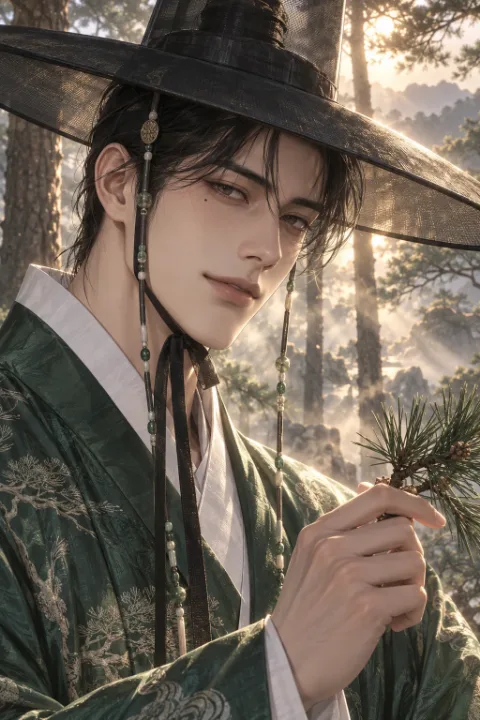
The Yang Wood Monkey Day Pillar — 甲申 Jia Shen (갑신)
The Yang Wood Monkey Day Pillar, written 甲申 and read gapsin in Korean, is the 21st pillar in the traditional 60-pillar cycle. About 1 in 60 people share this day pillar, which carries the nickname Blue Monkey.
What This Pillar Is Like
In Korean saju, a reading system close to Chinese BaZi but interpreted with Korean conventions, each day pillar pairs a heavenly stem with an earthly branch. Here the stem is Yang Wood, pictured as a tall tree or a sturdy forest beam. The branch is the Monkey, which belongs to the Metal element.
Picture a tall, upright tree growing on rocky, metal-rich ground. The tree wants to grow straight and strong, but the hard ground beneath it keeps testing and shaping its roots. That image of wood meeting resistant metal is the heart of this pillar: steady character built through pressure.
Personality and Inner World
People with this day pillar often carry the straightforward strengths of Yang Wood. They tend to be principled and upright, preferring honesty over shortcuts. Many act as natural pioneers, willing to step forward first and take the lead when a group needs direction.
There is also a protective streak, a tendency to look out for people around them, especially those who seem to need support. The Monkey branch adds a restless, adaptable energy. This is known as a travel branch, linked to movement, change, and a pull toward new places or new situations rather than staying still.
The twelve life stages describe a kind of seasonal mood for each day pillar. For this one, the stage is Transition, meaning the energy sits between one phase ending and another beginning. This can feel like a tendency to be between things, often resetting direction, learning through change rather than through staying in one lane.
Is this your Day Master?
Enter your birthday and meet your character among the Twenty — calculated with true solar time at your birthplace.
In Love and Close Relationships
In saju, the branch directly under the day stem is sometimes called the spouse palace, since it sits closest to the self and can color how someone shows up in close partnerships. Here, the Monkey branch holds something called Seven Killings, a pattern linked to charisma, resolve, and a strong sense of responsibility toward the people closest to them.
This tendency can show up as someone who takes relationships seriously and steps up under pressure rather than backing away. At the same time, this pattern is also associated with stress and a pull toward pushing too hard, so it may help to notice when effort turns into strain. These are tendencies only, not fixed outcomes, and they say nothing about what a partner will think or feel.
Work, Money Style, and Growth
The relationship between this stem and branch is sometimes called a controlling pairing, since the Metal branch restrains the Wood stem. In practical terms, this often points to a disciplined, pressure-tested style of growth. Challenges and obstacles are not simply bad luck here; they are described as the very thing that builds strength over time.
This can translate into work styles that favor structure, clear rules, and roles where leadership or protection of others is valued. The Monkey's travel energy suggests comfort with change, new environments, or work that involves movement rather than a fixed routine. Because the main hidden stem inside the Monkey branch is Metal, there is often an undercurrent of sharp, practical thinking paired with the tree's steady principles.
Tips for People Born on This Pillar
Since this pillar's growth comes through pressure, it can help to build in deliberate rest and recovery rather than only pushing through challenges. Recognizing early signs of strain, before they build up, supports the steady strength this pillar is known for.
The pull toward movement and change is a strength, but pairing it with a few fixed anchors, such as steady habits or a stable home base, can balance the restless Monkey energy. Leaning into the natural pioneering spirit is a good use of this pillar's energy, especially in situations where someone needs to step up and take initiative for a group.
Questions people ask
What does the Yang Wood Monkey Day Pillar (甲申, 갑신) mean?
It means the day stem is Yang Wood, pictured as a tall tree, sitting on the Monkey branch, which carries Metal energy and a restless, travel-linked quality. Together they describe a disciplined, pressure-tested personality pattern.
Is the Yang Wood Monkey Day Pillar a good or lucky pillar?
Saju does not label pillars as simply good or lucky. This pillar is linked to tendencies like leadership, resilience under pressure, and adaptability, which can be strengths or challenges depending on how they are used.
What is this pillar's compatibility with other day pillars?
This page focuses on the Yang Wood Monkey pillar on its own, so it does not cover specific matchups with other day pillars. In general, saju compatibility looks at how different stems and branches interact, rather than naming good or bad pairs.
How can I find my own day pillar or Day Master?
You can find your day pillar free on this site by entering your birth date, time, and place. The site converts your birth time to local solar time at your birthplace to calculate it accurately.
When does the Yang Wood Monkey day come around?
Day pillars repeat every 60 days. The next Yang Wood Monkey days are: Fri, Nov 6, 2026 · Tue, Jan 5, 2027 · Sat, Mar 6, 2027 · Wed, May 5, 2027 · Sun, Jul 4, 2027 · Thu, Sep 2, 2027. People born on this pillar often notice these days feel familiar.
Pillars that pair and contrast
Natural partner: 己巳 Yin Earth Snake — its stem combines with 甲 and its branch forms a six-harmony pair with 申, a classic sign of easy cooperation.
Opposite pillar: 庚寅 Yang Metal Tiger — stem and branch both clash with 甲申. Lively and stretching rather than bad; give each other room.
Real compatibility reads both full charts — check two birthdays.
Neighbouring pillars
Read your whole chart
Your day pillar is one of eight characters. See all four pillars, your five elements and your 2027 — the first chapters are free.